

FloyIQ: Combining Visible Fish Identification with the Power of PIT Tag Technology
Sometimes the Best Innovation Comes from Combining Two Great Ideas
For decades, fisheries researchers have relied on external tags to identify fish, monitor movement, estimate harvest, collect angler-reported data and support mark-recapture studies.
One of the most recognizable examples is the Floy Tag.
You’ve probably seen them before: a brightly colored external tag attached to a fish with a visible identification number and, depending on the study, a message such as:
REWARD — CALL XXX-XXX-XXXX
It’s simple. It’s visible. And most importantly, someone who catches or encounters that fish immediately knows there’s a story attached to it.
But what if that same external tag could carry something else?
What if inside the body of that Floy Tag was a Voda IQ PIT tag with its own unique electronic identification number?
That’s the idea behind FloyIQ.
Why External Floy Tags Are So Valuable
One of the greatest advantages of an external fish tag is also the most obvious:
You can see it.
A researcher, angler or fisheries technician doesn’t need specialized equipment to recognize that the animal is part of a study.
The external tag can contain information researchers want someone to see, including:
- A unique identification number
- A telephone number
- Study or agency information
- A website
- A reward message
- Instructions asking anglers to report the fish
That visibility can turn anglers and members of the public into additional eyes in the field.
Imagine an angler catching a tagged fish hundreds of miles from where it was originally marked. They see the tag, record the number, call the telephone number and report when and where the fish was caught.
That single report can provide researchers with another valuable piece of information about the fish’s movement and fate.
But What If We Could Add Electronic Identification Too?
That’s where things get exciting.
Voda IQ and Floy Tag are working together to combine an external Floy Tag with Voda IQ PIT tag technology.
We call it:
FloyIQ
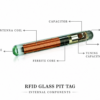
With FloyIQ, a Voda IQ 8 mm or 12 mm PIT tag is incorporated directly into the body of the external Floy Tag.
From the outside, researchers retain the benefits that have made external tags such a useful fisheries research tool.
On the inside, they gain the benefits of a uniquely coded electronic PIT tag.
It’s essentially two methods of identification working together in one tag.
Visible on the Outside. Electronic on the Inside.
Think about what that means in the field.
The Floy Tag Provides Visual Identification
If someone catches or handles the fish, they can immediately see that it has been tagged.
The external portion can carry the information needed for human interaction:
Tag Number: 001245
Reward
Call: XXX-XXX-XXXX
No reader required.
No antenna required.
The information is right there on the fish.
The Voda IQ PIT Tag Provides Electronic Identification
Inside the body of the FloyIQ tag is a Voda IQ PIT tag.
That gives the tag a unique electronic identity that can be read using compatible PIT tag equipment.
Depending on the research design and equipment being used, PIT tag technology can provide researchers with capabilities such as:
- Electronic identification
- Rapid tag reading
- Automated detection at PIT tag monitoring locations
- Reduced reliance on manually reading a printed number
- Integration with PIT tag readers and antenna systems
- Digital data collection
- Individual identification without needing to visually read the external tag
Now the same tagged fish can potentially interact with two different types of data collection.
Imagine the Research Possibilities
Consider a fish tagged with a FloyIQ tag and released into a river system.
An angler catches the fish.
They immediately notice the external tag and call the number printed on it.
Visual detection.
The fish may later encounter a PIT tag antenna where its embedded Voda IQ PIT tag is electronically detected.
Electronic detection.
A fisheries crew captures the fish during a sampling event. Instead of trying to read a small printed identification number on a wet, moving fish, the crew can scan the PIT tag.
Electronic identification.
Another angler catches the fish months later and reports the visible tag number.
Another visual encounter.
One fish.
One tag.
Multiple opportunities to collect information.
PIT Tag Data Without an Internal Implant
Traditional PIT tagging commonly involves implanting the PIT tag into the animal.
FloyIQ presents researchers with another potential approach.
Because the Voda IQ PIT tag is incorporated into the body of the external tag, the PIT tag itself does not need to be separately implanted internally.
For research programs already utilizing external tags, this creates an exciting opportunity to explore the benefits of PIT tag identification while maintaining a highly visible external marker.
Researchers can select a FloyIQ configuration incorporating either a:
Voda IQ 8 mm PIT Tag
or
Voda IQ 12 mm PIT Tag
depending on the study design, target species, tag configuration and research objectives.
Why Not Just Use a PIT Tag?
PIT tags are incredibly useful, but they aren’t visible.
An angler could catch a PIT-tagged fish and have absolutely no idea the tag is there.
Without a compatible reader, there’s generally no practical way for that person to identify the PIT tag or know that the fish is part of a study.
That’s where an external tag shines.
It communicates.
“This fish is part of a study.”
“Here’s its number.”
“Please report it.”
“Call us if you catch it.”
FloyIQ retains that immediate visual communication while adding electronic identification.
Why Not Just Use an External Tag?
External tags provide tremendous benefits, but their identification traditionally relies heavily on someone physically seeing and reading the tag.
A PIT tag adds another identification method.
Compatible PIT tag readers and antennas can electronically retrieve the unique identification code without someone having to manually read the external tag number.
That opens possibilities for researchers who want to combine angler reporting, physical recaptures and electronic detections within the same study.
The Best of Both Worlds
That’s really what FloyIQ is about.
Floy Tag brings visibility.
Voda IQ brings electronic identification.
Together, FloyIQ gives researchers a new tool that combines the strengths of both technologies.
| Floy Tag Benefit | PIT Tag Benefit | FloyIQ |
| Highly visible | Electronic identification | ✓ Both |
| Printed ID number | Unique digital ID | ✓ Both |
| Phone number/message | Reader-based identification | ✓ Both |
| Angler reporting | PIT antenna detection | ✓ Both |
| Easy visual recognition | Digital data collection | ✓ Both |
| Public participation | Automated detection potential | ✓ Both |
More Ways to Detect. More Ways to Learn.
Fisheries research rarely depends on just one piece of information.
Researchers want to know:
Where did the fish go?
Was it recaptured?
Did an angler catch it?
How long did it survive?
Did it pass a monitoring location?
Did it return?
Can we identify it again?
Every additional encounter has the potential to add another piece to that story.
That’s what makes the collaboration between Floy Tag and Voda IQ so exciting.
We’re taking a fish identification technology researchers have relied on for decades and combining it with modern PIT tag technology.
The result is something deceptively simple:
A visible tag with an electronic identity.
FloyIQ.
Visible on the outside. Smart on the inside.
Interested in FloyIQ for Your Next Fisheries Study?
Contact Voda IQ to discuss FloyIQ configurations incorporating 8 mm or 12 mm PIT tags, as well as PIT tag readers, antennas and data collection options for your research program.
Because when you’re studying fish movement, survival and behavior, the more opportunities you have to identify an individual fish, the more complete its story can become.






Add comment